

Many beverage producers, especially those filling carbonated drinks, are understandably cautious about moving to lighter weight glass bottles. The concern is straightforward, less glass means less strength. In reality, modern container manufacturing shows that strength is influenced far more by glass distribution than by total weight.
To understand this, it helps to look at the two main forming processes used to manufacture bottles: Blow & Blow (BB) and Narrow Neck Press & Blow (NNPB).

Glassworks International has been supplying our many UK customers with the highest quality glass packaging, providing outstanding value and dedicated service, nationwide for 25 years.

Stuart Alexander heads up our technical and quality department, providing a wealth of glass production experience and expertise gained over many years. Stuart is always on hand to offer support and advice and to answer any questions you may have.
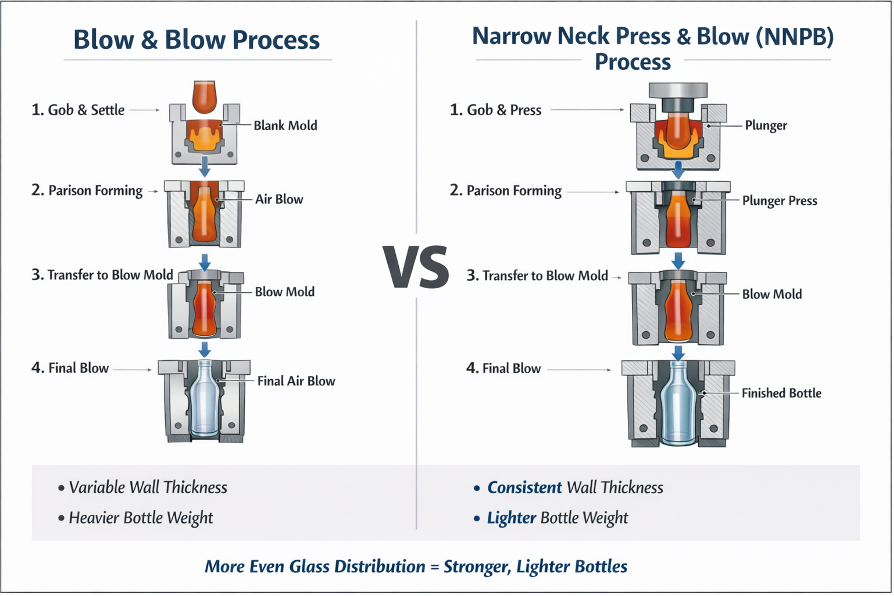
Side-by-side comparison of Blow & Blow and Narrow Neck Press & Blow (NNPB) forming processes.
The Blow & Blow process has historically been the most widely used forming method for glass containers.
In this process, a gob of molten glass drops into the blank mould. Compressed air is then used to form a preliminary shape called a parison. The parison is transferred to the final mould, where a second air blast expands it into the finished bottle.
Because air is responsible for stretching the glass during forming, the distribution of glass can vary around the container. Some areas may end up thicker, while others may become thinner.
These thinner areas can act as structural weak points, particularly when bottles are exposed to internal pressure from carbonation, impact during handling and filling, or rapid temperature changes during hot filling or pasteurisation.
To compensate for this variation, manufacturers often add extra glass weight. The additional material ensures that even the thinnest sections of the bottle still meet the necessary strength requirements. This is one reason why traditionally manufactured bottles can appear heavier.
The Narrow Neck Press & Blow (NNPB) process improves control during the first stage of bottle formation.
Instead of using air to create the parison, a mechanical plunger presses the molten glass into shape inside the blank mould. This pressing action distributes the glass far more evenly before the final blowing stage.
The result is much more consistent wall thickness throughout the container. With fewer thin spots, the bottle structure becomes significantly more efficient.
Because the glass is distributed more uniformly, manufacturers can reduce overall bottle weight while maintaining, or even improving, performance. In many cases, NNPB bottles demonstrate excellent internal pressure resistance for carbonated beverages, improved thermal shock resistance, and greater consistency from bottle to bottle.
Lightweight glass containers are not simply thinner versions of older bottles; they are the result of improved forming technology and better control of glass distribution. The result is packaging that uses less material while maintaining the strength needed for demanding applications.
And if you are considering lightweight glass packaging, Glassworks International can help you select the right container solution, balancing strength, performance and efficiency to suit your product and filling process.
Glassworks International has been supplying our many UK customers with the highest quality glass packaging, providing outstanding value and dedicated service, nationwide for 25 years.
Stuart Alexander heads up our technical and quality department, providing a wealth of glass production experience and expertise gained over many years. Stuart is always on hand to offer support and advice and to answer any questions you may have.
Glassworks International takes pride in keeping up to date with the latest technologies and trends within glass manufacturing and production.